
The Best SEO Automation Tools & Software for Small Business in 2026
The biggest SEO challenge for most small businesses isn't knowing what to do. It's finding the time and resources to actually do it.
You need to track what your competitors are ranking for. Identify the keywords you're missing. Create content that covers those topics better than what's already ranking. Optimize that content for Google search and AI platforms like ChatGPT and Perplexity. Monitor how everything performs. Update the pages that start slipping. Repeat.
Done properly, that's a full-time job — or several. For a small business with a lean marketing team, it's often the thing that gets started and then quietly falls behind everything else.
That's where SEO automation tools come in. The right one can compress most of that process and run it consistently, even when your team is focused on other things.
This list covers the tools we've tested and used with clients, with a focus on what they actually automate versus what they just make slightly easier.
What to Look for in an SEO Automation Tool
Before getting into specific tools, here's the filter we apply when evaluating anything in this category:
Does it handle execution, or just analysis? A lot of "automation" tools automate the research side — finding keywords, surfacing competitor data, generating reports. That's useful, but it's still leaving the hard work to you. True automation means content gets created and published, not just researched.
Does it run on an ongoing basis? SEO isn't a one-time project. A tool that automates a single burst of content and then sits idle isn't solving the underlying problem. You want something that keeps working — identifying new opportunities, refreshing content that's slipping, adapting to changes in the competitive landscape.
Does it target Google and AI search? Ranking on the traditional Google SERP is still critical, but a growing portion of search behavior now happens inside tools like ChatGPT, Perplexity, Claude, and Google AI Overviews. Tools that ignore the AI search side are already working with an incomplete picture.
Does it handle content intelligently? Volume isn't the goal. A tool that publishes 30 thin articles a month might look productive while actually creating keyword cannibalization issues and diluting your site's authority. Smart grouping and quality execution matter.
How We Evaluated These Tools
Every tool on this list was assessed against the four questions above, based on hands-on use with Tactycs clients in industries ranging from manufacturing and professional services to home services and insurance. We ranked tools by how much of the SEO process they actually take off your plate, not by feature count or brand recognition. For every tool, including our top pick, we've been specific about what it doesn't do.
Disclosure: Tactycs offers EvergreenAI to clients and manages its setup. It's held to the same criteria as every other tool on this list.
SEO Automation Tools & Software: Quick Comparison
Here's how the main tools in this category stack up before going deeper on each:
| Tool | What It Actually Automates | Strategy Layer | Pricing (Approx.) | Best For |
|---|---|---|---|---|
| EvergreenAI | Research, content creation, publishing, refresh cycles, AEO targeting | ✅ Built-in trigger system | Early access | Complete hands-off SEO system |
| SearchAtlas / OTTO SEO | Technical audits, fixes, content architecture | ✅ Platform-wide | $99–$399+/mo | Technical SEO + content in one platform |
| RankYak | Keyword research, article generation, CMS publishing | ❌ Manual | Mid-range | Teams with strategy in place |
| Semrush | Rank tracking, site auditing, reporting, competitor monitoring | ✅ Data only | $140+/mo | In-house SEO teams with execution resources |
| Ahrefs | Backlink monitoring, rank tracking, keyword research | ✅ Data only | $129+/mo | Experienced SEO teams, data-first workflows |
| SE Ranking | Rank tracking, site audits, white-label reporting | ✅ Data only | $129+/mo | Agencies and budget-conscious teams |
| Surfer SEO | Content scoring, on-page optimization, content audits | Partial (content planning) | [verify] | In-house writers optimizing individual pages |
| Screaming Frog | Technical site crawls, scheduled audits (paid) | ❌ Manual | Free up to 500 URLs; paid annual license | Technical SEO audits |
| Zapier / Make | Workflows connecting your SEO tools, sheets, and alerts | ❌ Manual | Free plans available; paid tiers vary | Custom no-code SEO workflows |
The core pattern: tools that handle execution tend to have thinner strategy layers. Tools with deep strategy capabilities leave execution to you. The ideal stack either combines both or includes a strategy partner managing the direction.

What Should You Actually Automate First? (A Practical Starting Point)
Most small businesses don't need to automate everything at once. The fastest path to results is identifying where manual SEO is creating the biggest bottleneck and fixing that first.
Here's a practical order of operations:
Start with rank tracking and reporting. This is the lowest-friction automation win. Tools like Semrush, Ahrefs, and SE Ranking will automatically track your keyword positions and send alerts when something moves. This alone saves hours of manual checking and ensures you're not the last to know when a page drops.
Next, automate competitive monitoring. Knowing when your competitors publish new content or gain on a keyword you care about is actionable intelligence. EvergreenAI does this continuously via competitor triggers. For teams using Semrush, setting up keyword gap alerts achieves a similar result with manual follow-through.
Then automate content creation and publishing. This is where the biggest time savings live — and where the most risk is if done poorly. Tools that publish without quality controls create keyword cannibalization and thin content problems at scale. The right automation here isn't just volume; it's publishing content that's grouped correctly, matched to search intent, and structured for both Google rankings and AI citation.
Finally, automate content refresh cycles. Pages slip. Competitors update their content. New keywords emerge. A system that only creates new pages while letting existing ones decay is working against itself. Monitoring and refreshing existing content should be part of any automation stack, not an afterthought.
If you're not sure where to start with your own setup, our SEO team at Tactycs can audit where your time is going and help you prioritize which automation layer will move the needle fastest.
1. EvergreenAI — Best End-to-End Automation
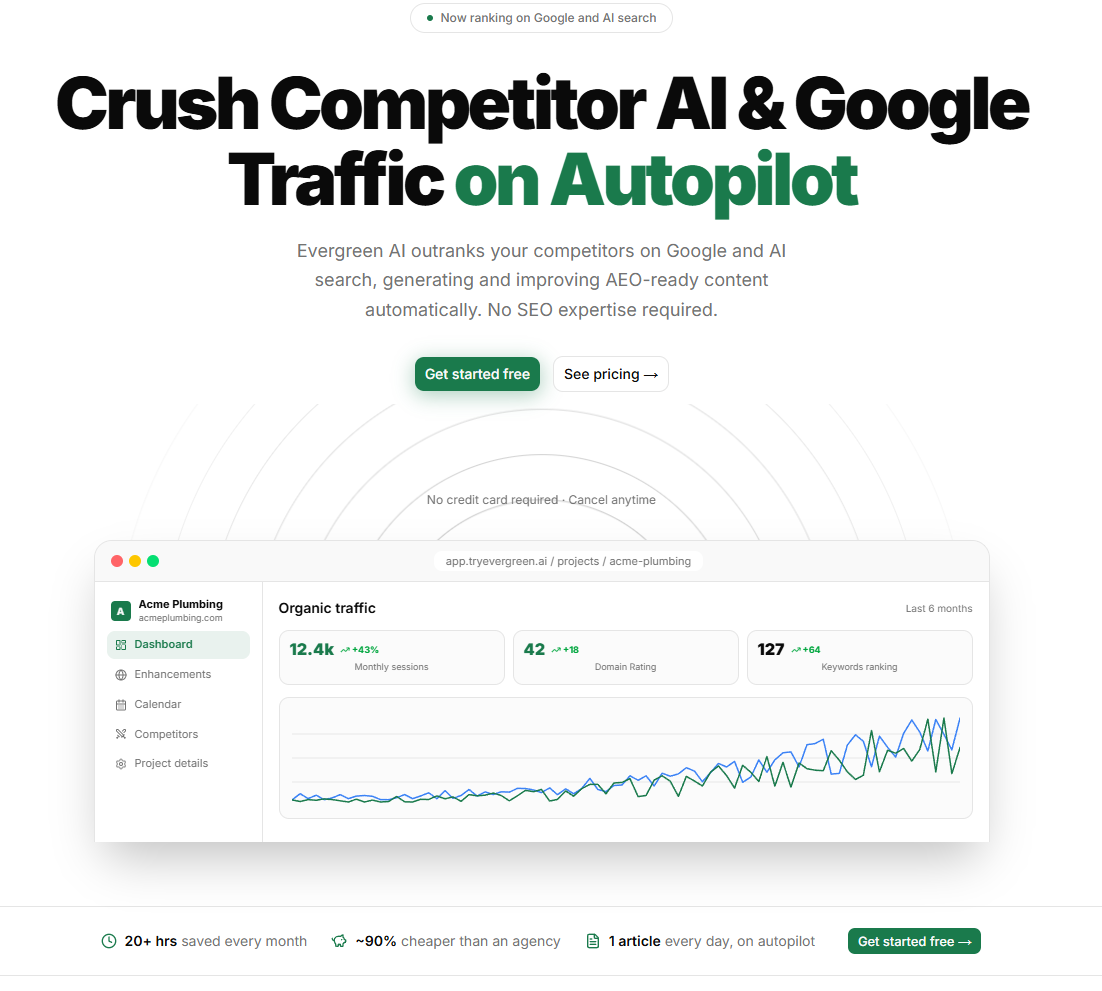
For small businesses with a lean marketing team that wants SEO to actually work without requiring full-time management, EvergreenAI is the tool we'd point to first.
The pitch isn't just automation — it's a complete, cycling system. Here's what it handles end to end:
Competitive intelligence:EvergreenAI monitors your competitors' best-performing content and identifies where you have a realistic opportunity to rank with a better version of it. This isn't a one-time audit — it runs continuously, so new opportunities get flagged as they emerge.
Keyword gap analysis: Rather than handing you a raw keyword list, the system evaluates gaps against what's actually ranking in the SERP and groups related keywords together. This prevents the cannibalization problem where separate pages targeting similar keywords end up competing against each other.
Content creation and publishing: Once an opportunity is confirmed, EvergreenAI builds the content — the right structure, headings, FAQ sections, and supporting detail — and publishes it directly to your site. The content is written around both traditional search ranking and AI platform citation.
AEO targeting: This is a differentiator that most automation tools don't have. EvergreenAI identifies the specific questions and conversational phrases that AI platforms like ChatGPT, Perplexity, Claude, and Google AI are pulling for relevant topics and builds them into every piece of content. As AI search continues to grow as a traffic source, this becomes more valuable.
Content enhancements: Automation tools that only create new content are leaving a significant opportunity on the table. EvergreenAI monitors your existing pages, identifies ones that are close to ranking but not quite there, and provides specific updates to push them up. A page sitting on page two of Google often needs less work than you'd think to move to page one — it just needs the right additions.
Ongoing monitoring and refresh cycles: When keywords trend up, the system capitalizes. When something slips, it catches it and triggers a refresh. SEO isn't a publish-and-forget process, and EvergreenAI is built around that reality.
Our team at Tactycs works with businesses to configure and manage EvergreenAI for their specific market. The tool handles the execution, and we handle the strategic layer — making sure it's targeting the right competitors, the right content types, and the right opportunities for each client's situation. If you're interested in getting set up, reach out and we'll walk you through it.
Best for: Small to mid-sized businesses with lean marketing teams that want SEO running consistently without it consuming all of their bandwidth.
2. SearchAtlas / OTTO SEO
SearchAtlas is a broader SEO platform, and their OTTO SEO engine is the automation piece worth paying attention to. OTTO handles automated site audits, technical SEO fixes, content architecture suggestions, and some content optimization — more of a full-platform approach than a focused content automation tool.
It's a solid option for businesses that want automation across more of their SEO stack, including the technical side. The content automation is less developed than EvergreenAI’s, but the platform covers more ground overall.
Best for: Businesses that want automation across technical SEO, content, and reporting in one platform.
3. RankYak
RankYak focuses on the content production side of automation — keyword research, article generation, and direct CMS publishing. If the main bottleneck is getting content written and published consistently, RankYak handles that at a reasonable price point.
The strategic layer is thinner. RankYak doesn't have the competitor monitoring, content enhancement cycles, or AEO targeting that a more complete system provides. You're getting automated content output, but the decisions about what to target and when to update are still yours to manage.
Best for: Teams that have SEO strategy handled and need a reliable, affordable pipeline for getting content produced and published.
4. Semrush
Semrush is included here because a lot of businesses treat it as an automation tool — it's not, but it's worth understanding what it actually does so you can decide if it fits your stack.
Semrush automates research and reporting. It surfaces competitive keyword data, tracks your rankings over time, audits your site for technical issues, and gives you a detailed view of the landscape. All of that happens automatically and gets surfaced in dashboards you can check regularly.
What Semrush doesn't automate is execution. The content that addresses those keyword opportunities still needs to be created and published by your team. For small businesses without dedicated SEO resources, Semrush gives you great data and then leaves you to figure out how to act on it.
If you have an in-house person who understands how to turn data into content strategy and execution, Semrush is a strong part of the stack. If you're looking for something that handles the work itself, it's not the right fit as a standalone tool.
Best for: Businesses with in-house SEO expertise that need reliable data and reporting automation.
5. Ahrefs
Same framework as Semrush. Ahrefs automates the data side — keyword research, rank tracking, backlink monitoring, competitive analysis. It's excellent at what it does, and the data is highly reliable.
But it's a research platform. The execution — content creation, publishing, ongoing updates — is your team's responsibility. For small businesses looking for something that runs the process for them, Ahrefs is a starting point rather than a complete solution.
Best for: Experienced SEO teams that need accurate competitive data to inform their strategy.
6. SE Ranking
SE Ranking is an all-in-one SEO platform that covers much of the same ground as Semrush: rank tracking, site audits, competitor research, and keyword tools. It's especially popular with agencies because of its white-label reporting. The automation is on the monitoring side, with scheduled rank checks, recurring audits, and client reports that build themselves.
Like Semrush and Ahrefs, it doesn't create or publish content. It shows you where the opportunities are, and your team still has to act on them.
Best for: Agencies and budget-conscious teams that want Semrush-style monitoring and automated reporting.
7. Surfer SEO
Surfer focuses on on-page content optimization. Its content editor scores a draft against the pages already ranking for your target keyword and suggests terms, headings, and length. Its audit feature does the same for pages you've already published. Surfer also offers AI-generated drafts.
Surfer makes optimized content faster to produce, but it's an assisted workflow rather than a fully automated one. Someone still decides what to target, reviews the draft, and publishes it.
Best for: Teams writing content in-house who want a data-backed way to optimize every page.
8. Screaming Frog SEO Spider
Screaming Frog is the industry-standard technical SEO crawler. It crawls your site the way a search engine would and flags broken links, redirect chains, missing or duplicate titles and meta descriptions, and other technical issues. The paid version can schedule crawls and export results automatically, so problems surface without anyone remembering to run an audit.
It's purely technical, with no keyword research or content features. The free version crawls up to 500 URLs, which covers many small business websites.
Best for: Technical audits and catching site issues before they cost you rankings.
9. Zapier / Make
Zapier and Make aren't SEO tools. They're workflow automation platforms that connect the tools you already use. Depending on which integrations your stack supports, you can post an alert to Slack when a tracked keyword drops, add every new blog post to a content refresh calendar, or pull weekly data from several tools into one Google Sheet.
They're useful glue for an existing stack, but they don't make any SEO decisions or do any SEO work on their own.
Best for: Teams that already have SEO tools in place and want them connected without hiring a developer.

SEO Automation Software: What's Different For Local Businesses
Most SEO automation tools are built around content and keyword ranking — which covers a lot of ground, but misses something critical for local businesses: local search visibility.
If you run a business that serves a specific geographic area — a law firm, a contractor, a clinic, a retail shop — a significant portion of your potential customers are finding you (or not finding you) through Google Maps, local pack results, and location-specific queries. That's a different ranking system from the standard Google SERP, and it requires different automation.
What local SEO automation looks like in practice
Google Business Profile management — keeping your hours, services, photos, and posts updated automatically. Tools like BrightLocal and Localo handle this, and some broader platforms like SearchAtlas include it as part of their local SEO module.
Local citation consistency — making sure your business name, address, and phone number are consistent across directories automatically. Inconsistencies here actively suppress local rankings.
Location-based content pages — creating SEO-optimized pages for each service area you operate in. This is where programmatic SEO and local SEO intersect: a template like "[Service] in [City]" can systematically build local ranking authority across your service region.
Local review monitoring — tracking and responding to reviews across Google, Yelp, and industry directories. Response velocity signals to Google that the business is actively managed.
If local search is a significant part of your business model, make sure the automation tool you choose specifically addresses it — most general-purpose SEO automation tools don't. Reach out to our team if you're unsure whether your current stack has the local layer covered.
SEO Automation Software for Entrepreneurs and Startups
Entrepreneurs and early-stage startups face a specific version of the SEO problem: you know content and search visibility matter, you don't have a dedicated person to own it, and you can't afford to wait six months to figure out if something is working.
The tools that fit this situation have three things in common: low setup friction, minimal ongoing management, and execution that runs without you needing to check in on it daily.
What to prioritize at the startup stage
Skip the research-only tools for now. Semrush and Ahrefs are excellent — but they give you data and then expect you to act on it. If you don't have someone whose job it is to act on that data, you're paying for a dashboard you'll check occasionally and rarely convert into rankings.
Start with a system that publishes, not just recommends. The gap between "here are your keyword opportunities" and "here is a published article targeting those opportunities" is where most startup SEO efforts stall. Tools that close that gap automatically — EvergreenAI, RankYak — are more useful at this stage than tools that surface more data.
Target low-competition keywords first. As an early-stage domain, you're unlikely to outrank established players on competitive head terms. The programmatic SEO approach — targeting long-tail, specific queries with structured content — is the fastest way to build initial organic traction before your domain authority is strong enough to compete on broader terms. Our article on programmatic SEO examples walks through exactly how this works.
Set it up once, then leave it running. The real value of SEO automation for a founder or small team is that it doesn't require your ongoing attention to keep producing results. A system that needs constant manual input isn't actually automation — it's just a more expensive workflow.
If you're at the stage where SEO is important but not yet resourced, talking to us at Tactycs is often the fastest way to figure out which tool setup makes sense for where you are now versus where you're headed.
How Much Does SEO Automation Cost? (Budget Guide for Small Business)
One of the most common questions small businesses have before choosing an SEO automation tool is simply: what does this actually cost?
Here's a realistic breakdown by budget tier:
Under $50/month — Research automation only
At this level, you're getting rank tracking, basic keyword research, and site audit alerts. Tools like Mangools ($29/mo) and Ubersuggest fit here. You'll have data to work with, but execution is entirely manual. Good for solo operators who are comfortable doing their own SEO and just need reliable data.
$50–$150/month — Content automation entry point
This range covers tools like RankYak and Koala, which automate article generation and CMS publishing. You're getting volume, but the strategic layer — what to target, how to group keywords, when to refresh — is still your responsibility. Best for teams that have SEO direction figured out and need a faster production pipeline.
$150–$400/month — Platform-level automation
Semrush ($140+), SearchAtlas ($99–$399+), and similar platforms sit here. You get broader automation across research, technical auditing, and reporting. Content creation is partially assisted but rarely fully automated. Best for businesses with an in-house SEO resource who can act on the data and direction the platform provides.
Full-system automation — EvergreenAI + strategy partner
A complete, cycling SEO system — competitive monitoring, content creation, publishing, refresh cycles, and AEO targeting — paired with strategic oversight. This is the model we run with clients at Tactycs. The total investment depends on the scope of the engagement, but it replaces what would otherwise require a part-time SEO hire, a content team, and multiple tool subscriptions running in parallel.
For most small businesses, the question isn't which tier they can afford — it's which tier will actually move their rankings. A $29/month rank tracker won't outrank a competitor running a full automation system any more than a measuring tape will outbuild a construction crew. If you want to understand what the right investment looks like for your specific situation, book a free call with us.
Affordable SEO Automation: What "Cheap" Actually Gets You
"Affordable SEO automation" is a search that means different things depending on what you're trying to accomplish. Here's an honest breakdown of what different price points actually deliver — and where the hidden costs show up.
The $0–$30/month tier: Free and freemium tools
Google Search Console is free and genuinely useful — it shows you what you're already ranking for, which pages are gaining or losing impressions, and which queries are driving clicks. Paired with Google Analytics, it gives you the data layer of SEO at no cost. What it doesn't do: create content, audit competitors, or tell you what to do next. It's a measurement tool, not an execution tool.
Ubersuggest and Mangools sit at the low end of paid tiers ($29–$30/mo) and add keyword research and rank tracking. Still research-only. Execution is still on you.
The $50–$100/month tier: Content automation entry point
This is where tools like Koala and RankYak live. You get automated article generation and CMS publishing — real execution, not just data. The tradeoff is that keyword targeting strategy, grouping decisions, and refresh cycles are still manual. If you have someone who can handle the strategic direction, these tools are genuinely cost-effective for the production side.
Where "cheap" gets expensive
The hidden cost of budget SEO automation is usually wasted content. A tool that publishes 30 articles a month at $99 looks affordable — until those articles create keyword cannibalization issues, fail to index, or generate traffic that doesn't convert because intent was mismatched. Fixing that at scale costs more than getting it right the first time.
The most cost-effective approach for a lean team is usually a mid-tier tool paired with a one-time strategy session to configure it correctly — rather than the cheapest tool running on autopilot and producing results that need to be cleaned up later. If budget is a real constraint, reach out to us and we'll tell you honestly what makes sense at your stage.
SEO Automation With No SEO Experience: What Actually Works
One of the most common queries landing on this page comes from people who aren't SEO practitioners — they're business owners, marketers with broad mandates, or founders who need SEO to work without becoming an SEO expert themselves.
The honest answer: most SEO tools assume some baseline knowledge, and that assumption creates friction that causes a lot of people to give up before they see results.
Here's what actually works if you're starting without SEO expertise:
Use a tool that makes the decisions for you, not one that surfaces options for you to decide on. Research-heavy platforms like Semrush and Ahrefs are powerful — but they present you with data and expect you to know what to do with it. If you don't have that background, you'll spend a lot of time in dashboards without a clear next action. Tools like EvergreenAI, which use trigger systems to automatically determine what content to create and when, remove most of those decision points from your plate.
Prioritize tools with built-in keyword grouping. One of the most technically consequential SEO decisions — which keywords to group into a single page versus which to target separately — is also one of the least intuitive for non-practitioners. Getting this wrong creates keyword cannibalization problems that actively suppress your rankings. A tool that handles grouping automatically (as EvergreenAI does) protects you from that mistake without requiring you to understand why it matters.
Pair automation with a one-time strategy setup. Even the most hands-off tools require someone to point them in the right direction initially — which competitors to track, what content types to prioritize, how to configure triggers for your specific market. A single strategy session with an SEO team at the start can prevent months of automation running in the wrong direction. It's also significantly cheaper than diagnosing why six months of automated content didn't produce results. That's a core part of what we do at Tactycs when onboarding clients onto tools like EvergreenAI.
Don't confuse publishing velocity with SEO progress. More content is not inherently better. A tool that publishes daily without intent matching, keyword grouping, or quality control is producing volume, not rankings. If you don't have the expertise to audit what's being published, choose a tool that has quality controls built in rather than one that optimizes for output speed.
Automated SEO Services vs. DIY SEO Automation Software
When people search for automated SEO, they're often weighing two different options without realizing it.
DIY SEO automation software gives your team tools to run SEO yourself. You pick the tool, configure it, decide what to target, and monitor results. You pay for software access, and the outcome depends on how well your team uses it.
Automated SEO services pair automation with a team that manages it for you. The software handles execution at scale, and the service provider handles strategy: which competitors to track, which opportunities to prioritize, and when something needs a human decision. You're paying for outcomes, not just access.
Neither is better across the board. It depends on what you have in-house:
If you have someone with SEO experience and time to manage it, DIY software is usually the more cost-effective choice. Pick the category that matches your bottleneck and let that person run it.
If SEO has no owner on your team, DIY software tends to stall. The dashboards get checked occasionally, and the opportunities rarely turn into published content.
If you're somewhere in between, a hybrid works well. Automation handles execution, and a strategy partner sets the direction and checks in on results.
The hybrid model is how we run SEO at Tactycs. EvergreenAI handles research, content creation, publishing, and refresh cycles, and our team handles strategy for each client's market. If you're not sure which model fits your business, book a free call and we'll give you an honest recommendation, even if that's a DIY tool.

The Real Goal: Beating Competitors on Google and AI Search
Something worth keeping in mind when evaluating any of these tools: the goal isn't just to publish content. It's to show up where your potential customers are looking.
That used to mean page one of Google. It still does — but it increasingly also means showing up in the answers that ChatGPT, Perplexity, and Google AI give when someone asks a question in your space. Businesses that are ranking on both surfaces are capturing more of the available search traffic than businesses optimizing for just one.
Most of the automation tools in this category were built for the traditional Google SERP. EvergreenAI is one of the few that builds for both from the start.
For small businesses specifically, this combination — consistent competitive content creation on an automated cycle, targeting both Google and AI search — is the most complete picture of what SEO automation should look like in 2026. The businesses that get this working now are going to be a long way ahead of competitors who are still approaching it manually.
What Is Automated SEO Software? (And the 5 Types You'll Run Into)
Automated SEO software is any tool that performs recurring SEO tasks on a schedule or trigger, without someone doing each step by hand. Those tasks include tracking rankings, auditing your site, researching keywords, and creating or publishing content.
That's the key difference between SEO tools and SEO automation software. A standard SEO tool helps you do a task. Automation software does the task for you.
Most products marketed as "SEO automation" fall into one of five categories, and they automate very different parts of the process:
1. Rank tracking and reporting automation. These tools check keyword positions, monitor competitors, and build reports on a schedule. Examples include Semrush, Ahrefs, SE Ranking, and Mangools. They automate the data, but acting on it is still up to you.
2. Technical SEO automation. These tools crawl your site to catch broken links, redirect chains, duplicate metadata, and indexing issues. Some, like SearchAtlas OTTO, can also push fixes directly. Examples include Screaming Frog and SearchAtlas OTTO.
3. Content optimization software. These tools score a draft against the pages already ranking and tell you what to add. Surfer SEO is the best-known example. They make writing faster, but someone still has to write.
4. Content automation (creation and publishing). These tools research opportunities, create content, and publish it directly to your site. Examples include EvergreenAI, RankYak, and Koala. This is the category that replaces the most manual work, and it's where quality controls matter most. If you're comparing tools in this category specifically, our Outrank.so alternatives breakdown goes deeper.
5. Workflow automation. Platforms like Zapier and Make connect your existing tools so data moves between them automatically. They aren't SEO tools themselves, but they can tie an SEO stack together.
Most small businesses don't need all five. The right choice depends on where your biggest bottleneck is, and for lean teams that's almost always execution, not data.
Frequently Asked Questions
What is SEO automation?
SEO automation is the use of tools and software to handle repetitive SEO tasks — keyword research, rank tracking, content creation, technical audits, and content publishing — without requiring manual effort for each task. The goal is to run a consistent, effective SEO process even when your team doesn't have time to manage it manually.
Can a small business do SEO without an agency?
Yes, with the right automation tools. Tools like EvergreenAI handle the full cycle — competitive research, content creation, publishing, and refresh cycles — without requiring a dedicated SEO team. That said, the businesses seeing the strongest results typically pair automation tools with some level of strategic oversight, either in-house or through a partner like Tactycs.
What SEO tasks can actually be automated?
The tasks most effectively automated include: rank tracking and alerts, competitor keyword monitoring, technical site audits, content creation and CMS publishing, internal linking, and content refresh triggers. Tasks that still benefit from human judgment include: competitive positioning decisions, brand voice and editorial quality, and strategic prioritization of what to target first.
How long does it take for SEO automation to show results?
Most automated SEO systems begin producing indexable content within the first 30 days. Meaningful traffic growth typically appears within 60–90 days for low-competition keyword clusters. Full compounding results — where a growing library of indexed content generates consistent leads — generally develops over 3–6 months depending on domain authority and competitive landscape.
Is SEO automation safe? Will Google penalize it?
Automation itself is not penalized by Google. What Google penalizes is thin, duplicate, or low-quality content — which can result from poorly configured automation. Tools that publish volume content without quality controls, proper keyword grouping, or intent matching are the ones that run into problems. Well-structured automated content that provides genuine value is treated the same as manually written content.
What's the difference between SEO automation and AI-generated content?
SEO automation is a workflow system — it determines what to research, what to create, and when to publish. AI-generated content is a production method. The two are often combined, but automation without content quality controls produces the same problems as any other low-quality content strategy. The automation layer should be deciding what gets created; the content layer should ensure it's actually useful to readers.
What is the best tool to automate working with SEO data?
SEO data automation depends on what you need to do with the data. For surfacing and monitoring it — rank tracking, competitor gaps, site health — Semrush and Ahrefs are the strongest options. For tools that take SEO data and automatically act on it (creating and publishing content based on keyword opportunities and competitor signals), EvergreenAI is the most complete option for small businesses and agencies that want execution, not just reporting.
Can I do SEO automation without any SEO knowledge?
Yes, with the right tool. Research-heavy platforms like Semrush require some baseline SEO knowledge to use effectively — they surface data but expect you to know what to do with it. Tools like EvergreenAI use trigger systems to make the targeting and content decisions automatically, which significantly reduces the expertise required. For most non-practitioners, pairing an automation tool with a one-time strategy setup produces better results than running any tool fully unsupported.
What is automated SEO software?
Automated SEO software performs recurring SEO tasks like rank tracking, site audits, keyword research, content creation, and publishing on a schedule or trigger instead of by hand. Some tools automate only data collection and reporting. More complete systems, like EvergreenAI, also create, publish, and refresh content.
What are the best SEO automation tools in 2026?
For end-to-end automation that includes content creation and publishing, EvergreenAI is the most complete option. SearchAtlas OTTO combines technical and content automation in one platform. Semrush, Ahrefs, and SE Ranking are the strongest options for research and reporting automation. Screaming Frog leads for technical crawls, and Surfer SEO for on-page optimization.
Are there free SEO automation tools?
Yes, but they mostly cover data, not execution. Google Search Console is free and tracks your rankings, impressions, and clicks. Screaming Frog's free version crawls up to 500 URLs, and Zapier and Make both offer free plans for basic workflows. Content creation and publishing automation generally requires a paid tool.
Can SEO be fully automated?
Most SEO execution can be automated, including tracking, audits, content creation, publishing, and refresh triggers. Strategic decisions still benefit from human oversight: which competitors to target, how to position your business, and quality checks on what's being published. The strongest results come from pairing automation with strategic oversight.