
The Best Outrank Alternatives in 2026 (We Tested These With Real Clients)
We've been managing SEO for small and mid-sized businesses long enough to know that finding a tool that actually does the work is harder than it sounds. Most SEO tools fall into one of two camps: they're great at research and analysis, or they automate content production but do it sloppily.
Outrank.so sits in an interesting spot. The pitch is appealing — automated content, direct CMS publishing, keyword research handled for you. For businesses that don't have a full SEO team, that sounds like exactly what they need.
After running it on real client accounts, though, we ran into some consistent issues. The one that stood out most was keyword grouping. We'd see the tool flag "hot tub sanitizer" and "hot tub water sanitizer" as two separate content opportunities and push them as individual articles. That's a problem. Targeting near-identical keywords across separate pages splits your authority and sets you up for keyword cannibalization — Google has to decide which page to rank, and often neither performs as well as a single, properly structured piece would.
The other issue is what happens after content goes live. Outrank.so publishes and moves on. Real SEO doesn't work that way. Rankings shift, competitors update their content, new keywords emerge, and existing pages need attention. A tool that treats publishing as the finish line is only solving part of the problem.
Here are the best alternatives we've found and tested, starting with the one we think does this the right way.
Why People Leave Outrank.so: The Actual Problems
Most "alternatives" articles skip the honest part. Here's what actually pushes businesses off Outrank.so after they've tried it:
Keyword cannibalization from poor grouping: Outrank.so's automated topic suggestions frequently flag near-identical search queries as separate content opportunities. Publishing separate articles for "hot tub sanitizer" and "hot tub water sanitizer" doesn't double your traffic — it splits your authority and forces Google to pick a winner between two pages that should have been one. We saw this consistently across client accounts.
No content refresh cycle: Outrank.so publishes and moves on. Rankings shift, competitor content gets updated, and algorithm changes happen — but the tool has no mechanism for flagging underperforming pages or triggering updates. Over time, that means a growing library of content quietly losing ground with no system to catch it.
Backlink exchange risk: Outrank.so includes an opt-in backlink exchange network. The economics are appealing, but automatically exchanging links with other Outrank users' sites sits uncomfortably close to what Google's link scheme policies flag. It's worth understanding before enabling.
No AI search visibility: Outrank.so optimizes for Google rankings. It doesn't address how content performs in ChatGPT, Perplexity, or Google AI Overviews — where a growing portion of search queries now resolve without a click. If GEO visibility is part of your strategy, this is a real gap.
None of these are dealbreakers for every use case. But if any of them describe why you're looking for alternatives, they're worth filtering for when evaluating what's next.
Outrank.so Alternatives Compared: Quick Breakdown
Before going deeper on each tool, here's how the main alternatives compare at a glance:
| Tool | Best For | Content Automation | Strategy Layer | Pricing (Approx.) |
|---|---|---|---|---|
| EvergreenAI | Complete, ongoing SEO system | ✅ Full | ✅ Built-in triggers | Early access |
| RankYak | Teams with strategy in place | ✅ High | ❌ Manual | Mid-range |
| Koala | Budget-conscious volume publishing | ✅ Basic | ❌ Manual | Low |
| Semrush | In-house SEO data needs | ❌ None | ✅ Research only | $140+/mo |
| Ahrefs | Experienced SEO teams | ❌ None | ✅ Research only | $129+/mo |
| Outrank.so (for reference) | Set-and-forget volume publishing | ✅ High | ❌ Limited | $99/mo |
The core tradeoff across this entire category is automation depth vs. strategic control. Tools that publish automatically tend to sacrifice keyword grouping, intent matching, and content refresh cycles. Tools that prioritize strategy require you to do the execution yourself. EvergreenAI is the only option we've tested that handles both without treating one as optional.
Not sure which fits your situation? Talk to our team — we'll point you in the right direction in under 10 minutes.
1. EvergreenAI — Top Pick
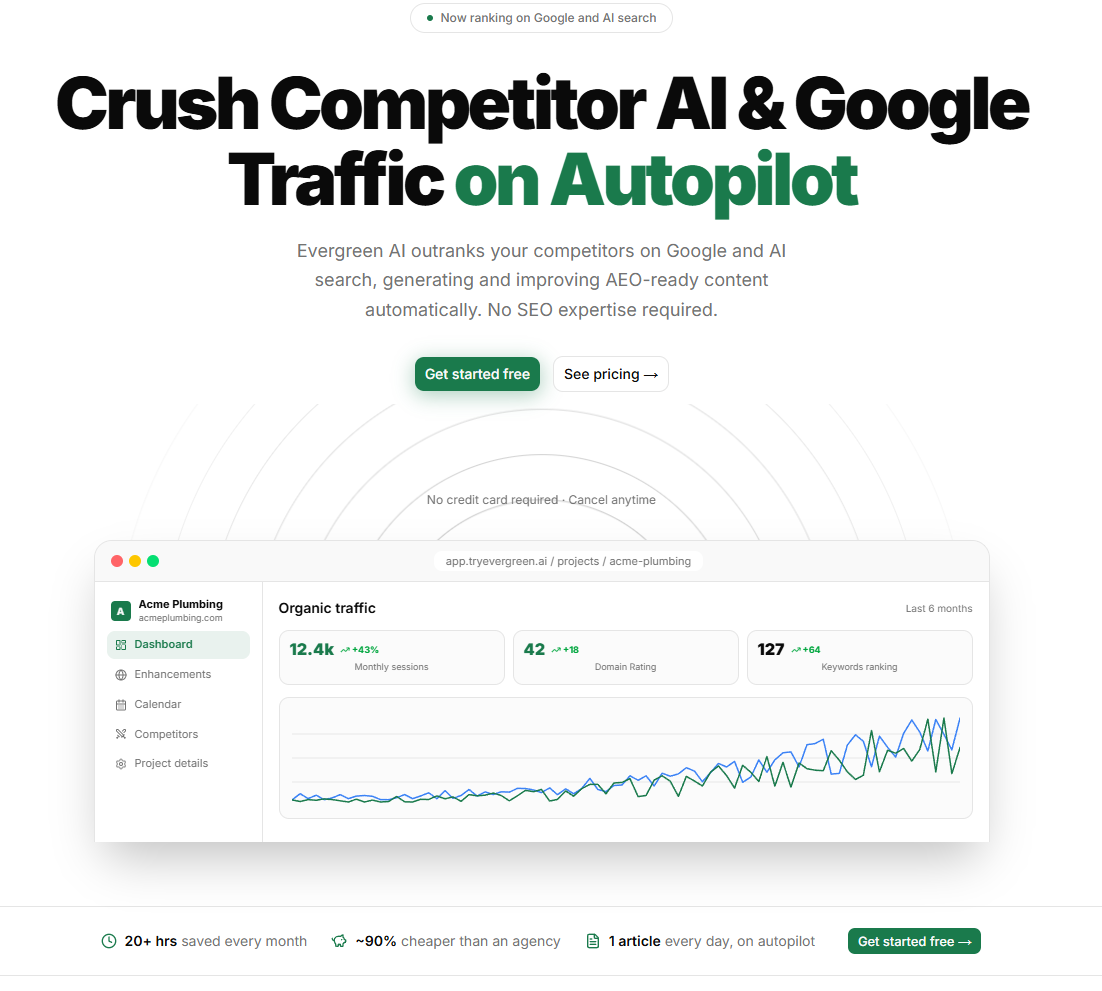
EvergreenAI was built around a pretty specific insight: execution is where most SEO tools fall short. Anyone can surface keyword opportunities. The hard part is turning those opportunities into content that actually ranks, and then keeping it there.
The system works in cycles rather than one-off publishing runs. It starts by analyzing what's working for your competitors, then builds content designed to beat it. But what feeds the content calendar isn't just competitor data. EvergreenAI pulls from three types of triggers:
Competitor triggers look at your competitors' best-performing content and identify where you can create a better, more thorough version of it. It looks at what's ranking, why it's ranking, and what a stronger version of that content would need to include.
Google Search Console triggers monitor your existing keyword performance. When something is trending up, the system capitalizes on it. When something is slipping, it flags the page for a refresh rather than letting rankings quietly erode.
AEO triggers identify the niche questions and conversational phrases that AI platforms like ChatGPT, Claude, Perplexity, and Google AI are pulling when users search for topics in your space. Content gets built to rank for those answers directly.
The keyword grouping is also handled properly. Related keywords get treated as a single content opportunity with the right structure, not split across multiple pages that end up working against each other.
One thing worth calling out: like any AI-driven system, the results are meaningfully better when someone who understands SEO strategy is involved in the setup. The tool handles the execution, but knowing which competitors to track, how to prioritize content types, and how to configure triggers for a specific market takes some experience. Our team at Tactycs works directly with businesses to get that configuration right and manage the ongoing strategy layer.
EvergreenAI is currently accepting early access signups. If you want to get set up and have someone walk you through it, reach out to us directly.
Best for: Businesses that want a complete, ongoing SEO system that handles research, creation, publishing, and content updates without treating any of those as optional.
2. RankYak
RankYak handles keyword research, article generation, and direct CMS publishing, which puts it closer to the automation end of the spectrum than most tools on this list. For businesses that want a steady flow of content without a lot of manual input, it's a reasonable option.
The gap compared to EvergreenAI is in the strategy layer. RankYak doesn't have the same trigger system or ongoing content cycle. You're getting automated content production, but the decisions about what to target and when to refresh are still on you. If you have someone managing that side of things, it can work well as a production tool.
Best for: Teams that have SEO strategy handled and need reliable, automated content output to execute against it.
3. Koala
Koala is one of the more affordable options in this category. It generates SEO-optimized articles at a lower price point than most competitors, which makes it worth looking at for smaller businesses or teams that want to test automated content before committing to a bigger system.
The tradeoff is depth. Koala produces content, but the research and strategy layer is thin. You're still identifying targets, grouping keywords, and deciding when to update existing pages yourself. It's a writing tool with SEO features rather than a full SEO system.
Best for: Smaller budgets, high content volume needs, or teams comfortable handling their own SEO strategy and just looking for faster production.
4. Semrush
Semrush is the standard for competitive SEO research. If you want to understand what your competitors rank for, find keyword gaps, audit your site's technical health, or track your rankings over time, nothing does it better.
But Semrush is fundamentally an analysis tool. It tells you what needs to happen. The content creation, publishing, and ongoing updates are still your responsibility. For businesses that have a dedicated SEO person who can turn data into action, it's an excellent part of the stack. For businesses looking for something that handles the execution side, it's not the right fit on its own.
Best for: Teams with in-house SEO expertise that need best-in-class data to inform their strategy.
5. Ahrefs
Ahrefs has some of the most reliable keyword and backlink data available, and their Content Explorer and Site Explorer tools are genuinely useful for understanding the competitive landscape. Like Semrush, it's a research tool first.
The distinction we make with clients is this: Ahrefs shows you the picture. It doesn't paint it. If your team already knows how to act on data, Ahrefs gives you great data. If you're looking for a system that moves from insight to published content automatically, you'll hit a wall.
Best for: Experienced SEO teams that prioritize data accuracy and do their own content strategy and execution.
A Note on AI Tools and Expert Direction
Something we see consistently across all of these tools: the results are better when someone who understands the strategy is involved, not just the software.
AI-powered SEO systems are only as good as the direction they're given. Which competitors to track, how to group content opportunities, what triggers to prioritize, how aggressive to be on new content versus refreshes — these are judgment calls that matter. The businesses getting strong results from tools like EvergreenAI aren't just turning them on and walking away. They're pairing good tools with good strategy.
That's true across every category of AI tool right now. The people getting the best outcomes are the ones who know how to direct the system well. If you want help with that side of things, whether that's getting set up on EvergreenAI or having our team manage the strategy layer on an ongoing basis, that's exactly what we do at Tactycs.
What About AI Search? How These Tools Handle ChatGPT and Perplexity Visibility
Traditional SEO tools, including most Outrank.so alternatives, were built to rank on Google. That's increasingly only part of the job.
Search behavior is shifting. A growing share of queries now resolve inside ChatGPT, Perplexity, and Google AI Overviews rather than on a results page. The content that gets cited in those AI-generated answers follows different rules than what ranks on page one: it needs structured formatting, clear answer blocks, FAQ schema, original data points, and accessible crawling for AI bots (GPTBot, ClaudeBot, PerplexityBot).
Of the tools covered in this article, only EvergreenAI's AEO trigger system specifically builds content designed to be cited in AI-generated answers. The others — RankYak, Koala, Semrush, and Ahrefs — either don't address AI search or treat it as a secondary consideration.
If your audience is already asking questions in ChatGPT or Perplexity, content that only targets Google keywords is leaving citations — and the traffic and leads that come with them — on the table.
Tactycs addresses this directly through our Ads in AI and GEO services, which are designed to make content visible across both traditional and AI search surfaces. It's a meaningful part of what we configure for clients using EvergreenAI.
Which Tool Is Right for You?
Want a complete system that researches, creates, publishes, and refreshes content automatically?EvergreenAI is the pick.
Have your strategy figured out and need reliable automated content production? RankYak or Koala, depending on your budget.
Have an in-house SEO expert and need accurate data to drive their decisions? Semrush or Ahrefs.
The right answer depends on how much of the process you want handled for you. If the reason you're looking at Outrank.so alternatives is that you need a system that keeps working after the first article publishes, EvergreenAI is where we'd point you.
Looking for a WooRank Alternative? Here's Where It Fits
WooRank shows up frequently in searches from people who've outgrown their current SEO audit setup, so it's worth addressing directly.
WooRank built its reputation as an accessible SEO scoring tool — you enter a URL, get a visual audit report, and walk away with a prioritized list of fixes. For complete beginners who want a quick read on their site's health, it does that reasonably well. The problem is that at $80–$200/month, it's priced alongside tools that do significantly more, and its audit depth hasn't kept pace with what modern SEO actually requires.
The main reasons people look for WooRank alternatives
Shallow audit coverage. WooRank checks around 70 on-page factors. Tools like Screaming Frog, Sitebulb, and Semrush audit hundreds, including JavaScript rendering, Core Web Vitals, redirect chains, orphan page detection, and structured data validation — all of which matter in 2026.
No competitive intelligence. WooRank tells you what's wrong with your site. It doesn't tell you what your competitors are ranking for, where your keyword gaps are, or how to beat them. That strategic layer is missing entirely.
No content automation. Like most audit-first tools, WooRank surfaces problems but leaves the execution — content creation, publishing, ongoing optimization — entirely to you.
Pricing that's hard to justify. At its price point, Ahrefs ($129/mo) and Semrush ($140+/mo) both offer deeper data across auditing, keyword research, rank tracking, and competitive analysis. The value proposition for WooRank specifically has become difficult to defend.
If you're coming from WooRank, here's where each tool in this article fits your situation
If what you valued in WooRank was the site audit and technical diagnostics, Semrush or SearchAtlas/OTTO SEO gives you far more depth at a comparable price. If you also need automated fixes rather than just a report, OTTO SEO's automated technical remediation is worth looking at specifically.
If you wanted WooRank to show you what to fix and then handle the fixing — which WooRank never really did — that's where a full execution system like EvergreenAI or working with an SEO agency like Tactycs closes the gap. The goal was always to improve rankings, not to generate audit reports. The tools and approach that actually get you there are further up this page.
Not sure which direction makes sense for your business? Book a free call with us and we'll give you a straight answer in under 10 minutes.
Do You Need a Tool or a Strategy? (How to Decide)
Most businesses shopping for an Outrank.so alternative are actually trying to answer a different question: how much do I want to hand off?
There's a spectrum here, and being honest about where you sit on it will save you a tool subscription that doesn't fit.
You need a tool if:
You have someone in-house who understands SEO strategy and can configure, monitor, and adjust the system
Your content goals are well-defined — you know your keyword targets, your content types, and your publishing cadence
You're comfortable spotting keyword cannibalization, thin content, and intent mismatches before they scale into problems
You need a strategy partner if:
You're buying the tool because you want SEO handled, not because you want to manage an SEO system
You've run tools before and seen content published but rankings not improve
You want to compete in AI search (ChatGPT, Perplexity, Google AI Overviews) as well as traditional Google — which requires a different content architecture than most tools support out of the box
Tactycs sits in the second category. We work with businesses to build the strategy layer that tools like EvergreenAI execute against — deciding what to target, how to configure triggers, how to structure content for AI citation, and how to audit what's working over time. If that sounds closer to what you actually need, our SEO services page has more detail, or you can book a free call here.
Frequently Asked Questions
What is Outrank.so?
Outrank.so is an AI SEO content platform that automates keyword research, article generation, and CMS publishing. For $99/month it publishes up to 30 articles per site. It's designed as a set-and-forget content automation system, not a strategic SEO tool.
Is Outrank.so worth it?
For high-volume content publishing on a tight budget, Outrank.so offers strong per-article economics. The gaps are in keyword grouping quality, content refresh cycles, and AI search optimization. Businesses that need more than automated publishing — strategic keyword clustering, ongoing content audits, or GEO visibility — typically outgrow it quickly.
What is the best free alternative to Outrank.so?
Most direct alternatives to Outrank.so don't have meaningful free tiers — the category is built around automated publishing volume, which requires infrastructure. Koala offers the lowest entry-level price point. For a fully managed option, speaking with an agency like Tactycs about what fits your budget is often more cost-effective than stringing together multiple tools.
How is EvergreenAI different from Outrank.so?
Outrank.so publishes content on a fixed schedule based on automated keyword research. EvergreenAI uses three types of triggers — competitor performance, Google Search Console data, and AI search query patterns — to determine what content to create and when to refresh existing pages. The core difference is that EvergreenAI treats SEO as an ongoing cycle, not a publishing cadence.
Do these tools help with ranking in ChatGPT or Perplexity?
Most tools on this list were built for Google rankings and don't specifically address AI search visibility. EvergreenAI's AEO trigger system is the exception — it identifies the queries AI platforms are surfacing and builds content to match them. For businesses that want to appear in AI-generated answers, GEO-specific strategy is needed alongside or instead of traditional content automation.