
Estimated read time: 12 min | Published by Tactycs
Most small businesses treat SEO like a lottery. Pick a keyword, write a page, hope it ranks. Sometimes it does. Usually it doesn't. And when it does rank, it ranks for one thing, brings in a trickle of traffic, and plateaus.
There's a better model. It's called query fan out — and it's the framework behind why some businesses seem to rank for everything in their niche while others grind away on the same five keywords for years with nothing to show for it.
This article breaks down exactly what query fan out is, how it works, how to build one, and how it compares to every other content strategy you've probably already heard of. By the end, you'll have a clear picture of what it takes to actually dominate a topic in search — not just show up for one keyword.
What Is Query Fan Out? (Definition and Meaning)
Query fan out is an SEO content strategy based on the idea that any core topic — any seed query — naturally expands into dozens or even hundreds of related searches. Rather than targeting a single keyword with a single page, query fan out systematically maps the full landscape of how people search for a topic, then builds content to capture every meaningful cluster of that intent.
Here's the simplest way to visualize it: imagine dropping a stone into still water. The ripples that spread outward from the center are your fan out — every circle represents a new layer of search intent, moving from broad to specific, from educational to commercial.
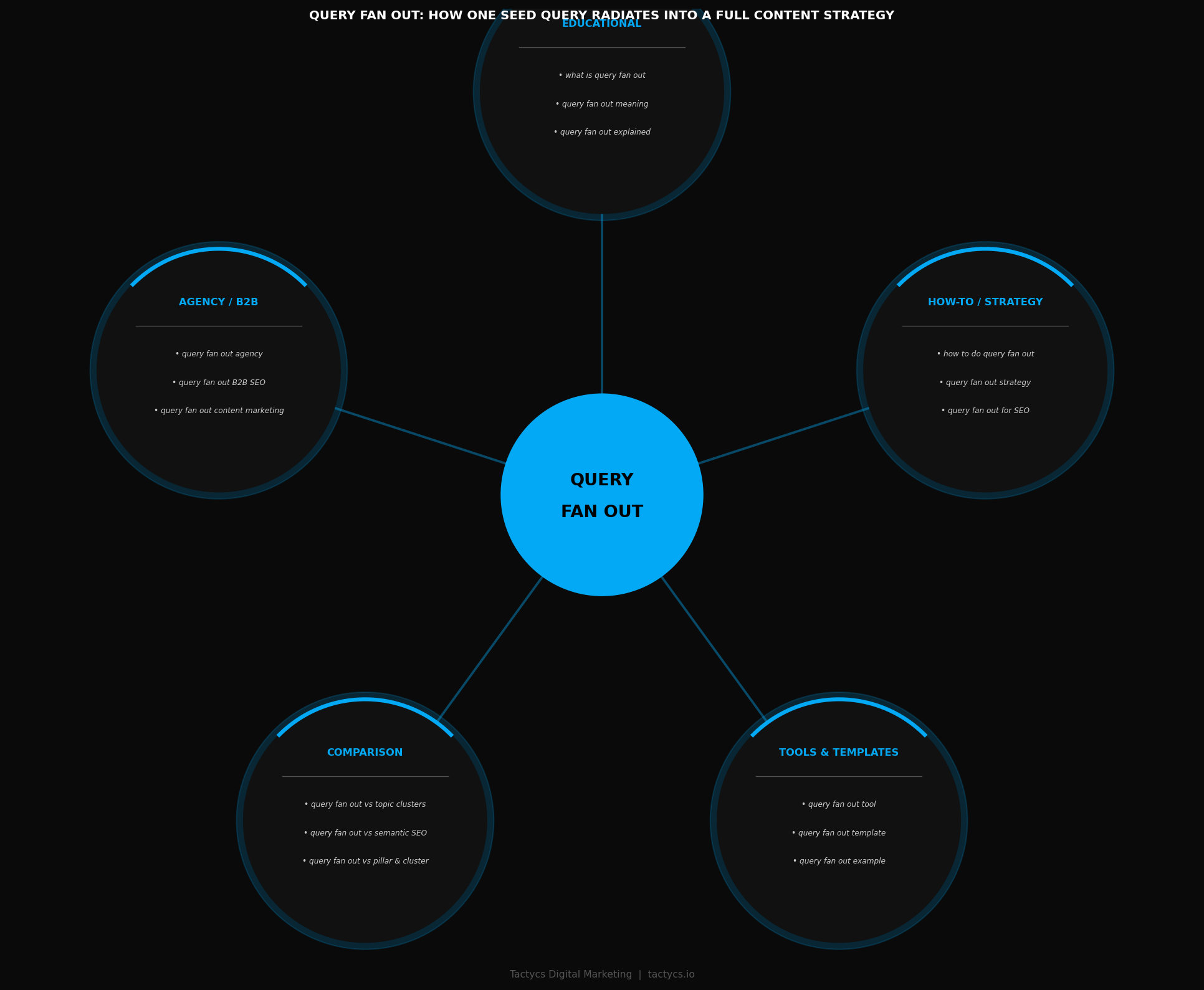
The seed query "query fan out" fans out into:
People learning the concept: "what is query fan out," "query fan out meaning," "query fan out SEO explained"
People wanting to apply it: "how to use query fan out for SEO," "query fan out strategy," "query fan out keyword research"
People comparing it to what they know: "query fan out vs topic clusters," "query fan out vs semantic SEO"
Practitioners looking for resources: "query fan out tool," "query fan out template," "query fan out example"
Each of those is a real search. Each has a real person behind it at a different stage of awareness and intent. A well-built query fan out captures all of them — not by writing thin, keyword-stuffed pages for each one, but by building a cohesive content structure that signals genuine expertise to Google.
That last part is the whole point. Query fan out isn't just a traffic hack. It's a framework for building topical authority — and topical authority is what determines whether Google trusts your site enough to rank it broadly, or just occasionally.
Why Query Fan Out Matters Right Now
Search has changed in ways that most small business websites haven't caught up to yet.
Google isn't pattern-matching keywords anymore. It's evaluating whether your website genuinely understands a topic. Its systems — Hummingbird, RankBrain, BERT, and now its AI-driven generative search features — are all built around the same core question: is this site an authority on this subject, or did they just happen to include the right words?
This shift is why semantic SEO strategy has replaced old-school keyword optimization as the dominant framework for sustainable rankings. Semantic SEO is the principle that you optimize for meaning, context, and expertise — not just keyword frequency. And query fan out is one of the most practical, actionable expressions of that principle.
Here's what that means for small and medium businesses specifically: you don't need a massive content budget to compete. You need a smarter content map.
A 15-article query fan out strategy, built around one core topic and executed well, will routinely outperform 100 random blog posts that have no thematic connection to each other. The random posts might each rank for something in isolation. The fan out builds momentum — each piece adds to the authority of every other piece, and over time, Google starts surfacing your content across the full query cluster, including for searches you didn't directly optimize for.
That compounding effect is the whole game. And query fan out is how you engineer it.
The Concepts You Need to Know (And How They Fit Together)
Query fan out doesn't exist in a vacuum. It sits at the intersection of several connected ideas that you'll hear in any serious SEO conversation. Here's how to think about them:
Topical Authority SEO The principle that Google rewards sites that demonstrably know a topic in depth over sites that have a single well-optimized page. A site with a dozen well-structured, well-linked articles on commercial landscaping will typically outrank a site with one heavily optimized "commercial landscaping services" page — even if the single page has more backlinks. Topical authority is what query fan out is building toward.
Semantic SEO Strategy Optimizing for meaning and context, not keywords. Semantic SEO involves using related terms naturally, answering the follow-up questions your audience actually has, and covering a topic in a way that signals you understand the subject — not just the search term. Query fan out is the strategic layer that makes semantic SEO executable.
Entity-Based SEO Google's Knowledge Graph connects entities — concepts, people, places, businesses, products — and understands how they relate to each other. Entity-based SEO means making sure your content connects clearly to the right entities in your space, so Google understands what your site is about, not just what keywords you used.
Topic Cluster Model SEO A content architecture where one "pillar" page covers a broad topic, and several "cluster" pages dive into subtopics — all linking back to the pillar and to each other. The topic cluster model is one of the most common structures used to implement query fan out.
Pillar Page Strategy Your pillar is your hub — the comprehensive, authoritative article that covers a topic at a high level. Cluster pages are the spokes that go deep on specific angles. The pillar links to clusters; clusters link back to the pillar. Together they tell Google: this site owns this topic.
Keyword Clustering Strategy Grouping keywords by shared intent to avoid creating competing pages that cannibalize each other's rankings. Keyword clustering is more tactical than query fan out — it's a cleanup exercise. Query fan out is generative: you're discovering the queries you should be targeting, including ones you never would have found in a traditional keyword research pass.
Search Intent Mapping Categorizing queries by what the searcher actually wants: informational, navigational, commercial, or transactional. Search intent mapping is what makes your query fan out strategy actually work — it ensures you're matching content format and depth to what the searcher needs at each stage.
The takeaway: query fan out is the strategy. Everything else is structure or tactic. Doing the fan out first makes every other framework more effective.
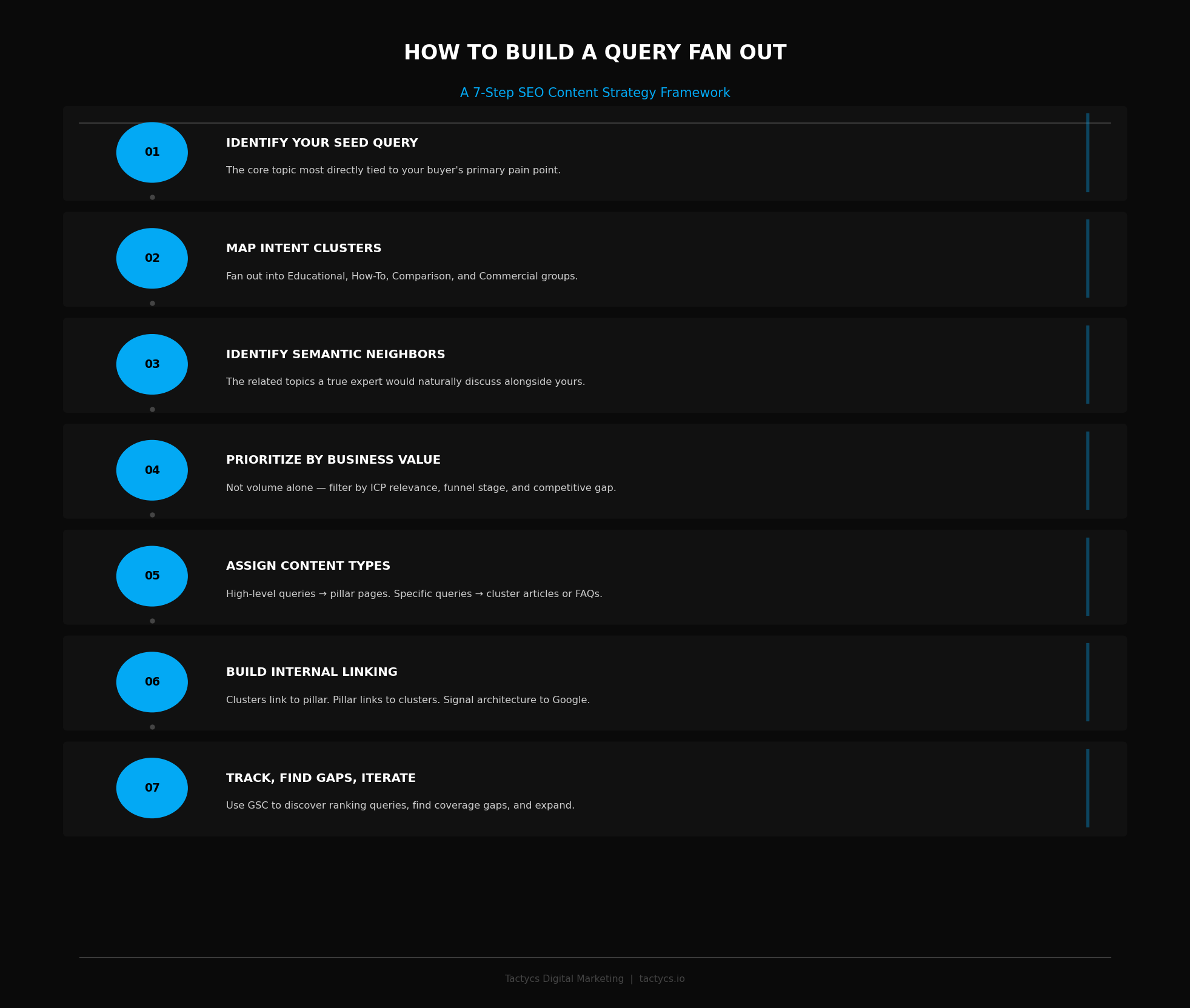
How to Build a Query Fan Out: Step-by-Step
Here's the actual process. This is what we run for clients at Tactycs before we write a single word of content.
Step 1: Identify Your Seed Query
Your seed is the core topic you want to own. It should be directly tied to what you do or sell — specific enough to be meaningful, broad enough to have depth. Examples: "email marketing for restaurants," "workers comp insurance small business," "custom logo design."
Resist the urge to start with the highest-volume term you can find. Start with the term most directly tied to your buyers' primary pain point.
Step 2: Map Intent Clusters
Fan out from the seed into intent-based groups. Every topic has at least four:
Educational / Definitional: "What is X," "X meaning," "X explained," "X definition" — these are people at the earliest stage of awareness
How-To / Strategic: "How to do X," "X strategy," "X process," "how to use X for Y" — these are people ready to act, looking for guidance
Comparison / Alternative: "X vs Y," "best X," "X alternatives," "X pros and cons" — these are people evaluating options
Commercial / Action: "X services," "X agency," "X pricing," "hire X," "X near me" — these are buyers
Don't filter at this stage. Get everything on the map first.
Step 3: Identify Semantic Neighbors
What topics does a genuine expert in this space naturally discuss alongside your seed? These are your semantic neighbor terms — the related entities and concepts that round out topical authority. For a bookkeeper: payroll taxes, cash flow forecasting, chart of accounts, year-end close. For a landscaper: irrigation systems, hardscaping, seasonal maintenance, lawn care vs. landscaping.
Google looks for these terms to gauge whether a site truly understands a topic, or just mentions the main keyword a lot. Mapping semantic neighbors is how you build a content plan that earns that trust.
Step 4: Prioritize by Business Value, Not Just Volume
Not every query in the fan out warrants a standalone piece of content. Prioritize by:
Search volume — is anyone actually searching this?
ICP relevance — is this the kind of person who would actually hire you?
Funnel stage — are you covering awareness, consideration, and decision evenly?
Competitive gap — where is your competition thin or weak?
The highest-volume query in your fan out is rarely the most valuable one. A lower-volume, high-commercial-intent query is often worth ten times more in actual leads.
Step 5: Assign Content Types and Build the Architecture
Map each query cluster to a content format. High-level, broad-intent queries → pillar pages or cornerstone articles. Specific, narrow queries → cluster articles, FAQ sections, or feature sections within a larger piece. Comparison queries → dedicated comparison pages or dedicated sections of existing content.
This is where query fan out becomes an actual content calendar and site architecture — not just a list of keywords.
Step 6: Build Internal Linking Intentionally
Every cluster article links back to the pillar. The pillar links to every cluster. Related cluster articles cross-link where relevant. This architecture does two things: it tells Google clearly which content is the hub and how everything relates, and it keeps readers moving through your content rather than bouncing after one page.
Most sites do this poorly or not at all. It's one of the highest-leverage, zero-cost improvements you can make.
Step 7: Track, Find Gaps, and Iterate
Query fan out is never truly finished. Use Google Search Console to monitor which queries you're actually ranking for — you'll often discover you're showing up for queries you didn't explicitly target, which reveals where your topical authority is growing. Find the gaps and fill them. Add new cluster content. Update pillar pages as your coverage expands.
This is how you turn a one-time content project into an organic visibility engine.
A Query Fan Out Example
Let's make this concrete. Say you're a commercial cleaning company in a mid-sized metro. Seed query: "commercial cleaning services."
Here's a partial fan out:
Educational cluster: "what is commercial cleaning," "commercial vs janitorial cleaning," "types of commercial cleaning services," "what does a commercial cleaner do"
How-to cluster: "how to choose a commercial cleaning company," "how to get a commercial cleaning quote," "how to vet a cleaning service for your office"
Comparison cluster: "commercial cleaning vs residential cleaning," "in-house cleaning staff vs cleaning company," "commercial cleaning company near me vs national franchise"
Semantic neighbors: OSHA cleaning standards, green cleaning products, floor care and maintenance, post-construction cleanup, disinfection services, day porter services
Commercial cluster: "commercial cleaning services [city]," "office cleaning company," "commercial cleaning for healthcare facilities," "commercial cleaning pricing per square foot"
FAQ / long-tail: "how often should an office be professionally cleaned," "how much does commercial cleaning cost," "what chemicals do commercial cleaners use"
Now you have a 20+ article content plan, a clear pillar ("commercial cleaning services — the complete guide"), and a semantic map that will make your site look like the definitive resource in this space to any search engine evaluating it.
The site that builds this architecture isn't just competing on "commercial cleaning services [city]." It's capturing everyone in the funnel — from the office manager just starting to research options all the way to the facilities director ready to send out an RFP.
Query Fan Out vs. Topic Clusters vs. Keyword Clustering vs. Pillar & Cluster
These terms get conflated constantly. Here's a clean breakdown:
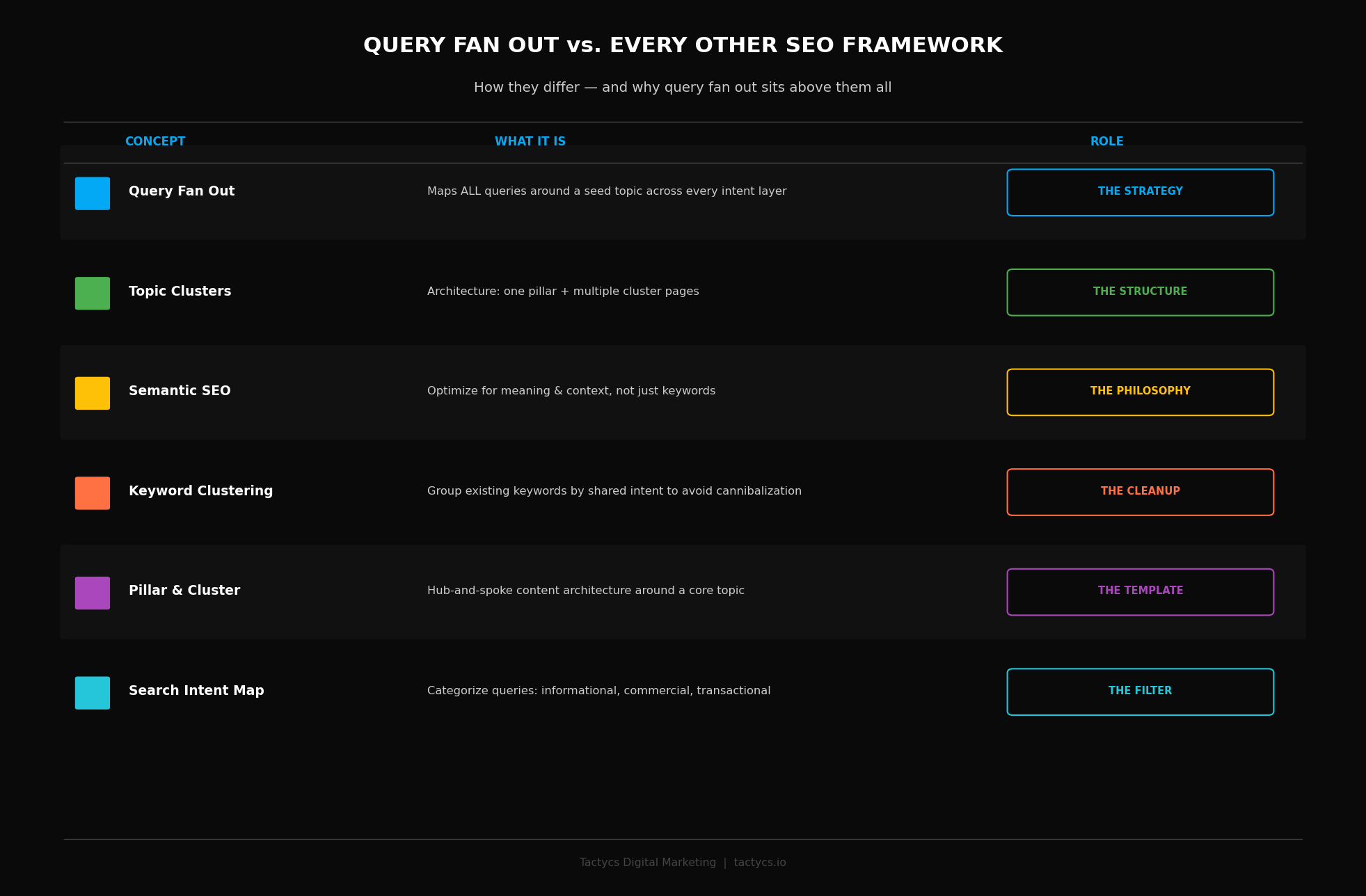
Query fan out vs. topic clusters Topic clusters are an architecture for organizing content. Query fan out is the strategy for deciding what content to create and why. You can build a topic cluster without having done a proper query fan out — and plenty of people do, with mediocre results. The fan out is what fills the cluster with the right content.
Query fan out vs. keyword clustering Keyword clustering groups existing, known keywords by shared intent to prevent cannibalization. Query fan out is generative — it's used to discover the full universe of queries you should be targeting, including ones a standard keyword research process would miss entirely.
Query fan out vs. semantic SEO Semantic SEO is the broader philosophy: optimize for meaning and context, not just keywords. Query fan out is one of the primary tactical methods for executing semantic SEO — it's how the philosophy becomes an actual content plan.
Query fan out vs. pillar and cluster Pillar and cluster is the most widely recognized content architecture in SEO. Query fan out is what informs it — the research that determines what your pillar covers, what your clusters address, and how they connect to each other.
One sentence: query fan out is the strategy layer that makes every other content framework work better.
Query Fan Out for Content Marketing and Blog Strategy
For most SMBs, the blog is both the best vehicle for query fan out and the most chronically misused asset on their website.
Most business blogs are random. A post about a product. A post about a team event. A post someone wrote because "we should be doing more content." None of it is connected. None of it builds on anything. And none of it compounds.
A query fan out-driven blog strategy is the opposite: every piece is intentional, mapped to a specific query cluster, and architecturally linked to a central pillar. Each article you publish doesn't just exist in isolation — it adds to the topical authority of everything around it.
Practically, for blog strategy, query fan out gives you:
A defined set of pillar articles — typically 4–8 — that anchor your entire content plan. Cluster articles (3–6 per pillar) that go deep on specific subtopics or intent layers. An editorial calendar that doesn't run dry because it's built from a systematic map, not whoever had an idea last Tuesday. And a clear SEO purpose for every piece, so you're not producing content just to produce it.
The difference between a blog that generates leads and one that doesn't is almost always this: the lead-generating blog is strategic. The other one is random.
Query Fan Out for B2B SEO
B2B SEO has characteristics that make query fan out not just useful, but essential:
Longer sales cycles. B2B buyers research for weeks or months before making contact. That means there are a lot of informational and comparison queries happening before any commercial intent appears. If your content only shows up at the bottom of the funnel — the "hire us" queries — you're missing most of the journey.
Multiple decision-makers. The person googling "what is [your service]" might be a junior analyst. The person googling "[your service] ROI" or "[your service] vs. alternative" might be the VP who signs off on the budget. Query fan out lets you map content to each persona and decision stage simultaneously.
Lower volume, higher value. B2B queries often have lower individual search volume than B2C. But the value per visitor is dramatically higher. Query fan out lets you aggregate value across dozens of related queries rather than gambling everything on a single high-volume term.
Trust and credibility at scale. B2B buyers evaluate you before they ever fill out a form. A site with deep, connected content on your topic signals expertise in a way that a thin five-page service site never can. Query fan out is how you build that depth systematically.
Query Fan Out Tools and Templates
There's no single purpose-built tool for query fan out yet — most practitioners stitch together a workflow:
Google Search Console — to identify queries you're already appearing for and find gaps in your coverage
Ahrefs or Semrush — for keyword research, competitor content gap analysis, and search volume data
People Also Ask / Related Searches — Google's built-in signals of how query clusters relate to each other
ChatGPT or Claude — useful for brainstorming semantic neighbor topics and intent cluster variations
A well-structured spreadsheet — to map, prioritize, and turn the fan out into an actual content calendar
Something better is coming. Our team is building a dedicated SEO and AEO tool designed specifically to automate query fan out research and content mapping for SMBs. What currently takes our team several hours of research will run in minutes — with output you can take straight into execution. If you want to be the first to know when it launches, reach out here.
In the meantime, our strategy sessions include a full query fan out walkthrough using the template our team has refined across dozens of client engagements. If you want to see what this looks like applied to your specific business and niche, book a call and we'll walk you through it.
Why Most SMBs Get This Wrong
Understanding query fan out and actually executing it are two different things. Here's where we see businesses consistently fall short:
Building the map and never using it. Query fan out research is valuable. A spreadsheet of queries is not a content strategy. The value is entirely in the execution.
Chasing volume over relevance. The highest-volume query in your fan out is rarely the most valuable one. Prioritizing by business value — not just search volume — is what makes this approach generate leads rather than just traffic.
Skipping internal linking. Content that isn't linked into your pillar architecture isn't contributing to topical authority the way it should. This is one of the most overlooked implementation details and one of the highest-leverage fixes.
Treating it as a one-time project. Search evolves. New queries emerge. Competitors enter your topic space. Buyers' language changes. Query fan out is a living strategy, not a one-and-done exercise.
Underestimating the execution lift. Done properly, building a full query fan out and executing on it — writing, optimizing, linking, updating — is months of consistent work. Most SMBs don't have that in-house capacity. That's not a knock; it's just an honest assessment of where agency support makes a real difference.
Ready to Stop Guessing and Start Building?
Tactycs is a boutique SEO and AEO agency working with small and medium businesses who are serious about building organic visibility that actually lasts.
We don't do vanity metrics. We don't sell you keywords, we build you an architecture. We start with a full query fan out mapped to your specific industry, buyers, and competitive landscape — then we execute: content, on-page optimization, internal linking, performance tracking, and iteration.
If you're curious what this looks like applied to your business, we'd love to take an honest look at where you stand.
No hard pitch. No obligation. Just a clear-eyed view of your current organic footprint and what it would realistically take to grow it.
Frequently Asked Questions
What is query fan out in SEO? Query fan out is the practice of mapping all the related searches that stem from a single core topic — then building a content strategy that covers each intent cluster. The goal is to capture organic traffic across the full landscape of how buyers search, not just one keyword.
How is query fan out different from keyword research? Traditional keyword research identifies existing terms to target. Query fan out is generative — it's used to discover the full universe of queries you should be targeting, including ones that might not show up as obvious keywords but represent real buyer intent.
How does query fan out help with topical authority? Topical authority is Google's assessment of how deeply your site understands a subject. When you build content that covers a topic from every meaningful angle — educational, strategic, comparative, commercial — Google starts to treat your site as the authoritative source, which leads to broader rankings across the full query cluster.
Is query fan out the same as topic clusters? Not quite. Topic clusters are a content architecture (pillar + cluster pages). Query fan out is the strategy used to determine what goes in that architecture. You can have topic clusters without query fan out; they just won't be as systematically built or comprehensive.
How long does it take to see results from a query fan out strategy? Typically 3–6 months before meaningful movement, with compounding results from month 6 onward. The timeline depends on domain authority, competition, publishing cadence, and execution quality. Agencies with established workflows and proven processes will move significantly faster than a first-time DIY attempt.
Do I need a tool to do query fan out? Not necessarily — the process can be run manually using Google Search Console, a keyword research platform, and a spreadsheet. That said, purpose-built tooling makes the process significantly faster and more thorough. We're building something designed specifically for this. Stay tuned.
Tactycs is a boutique SEO and AEO agency helping small and medium businesses build organic visibility that compounds. Learn more about our services or get in touch.